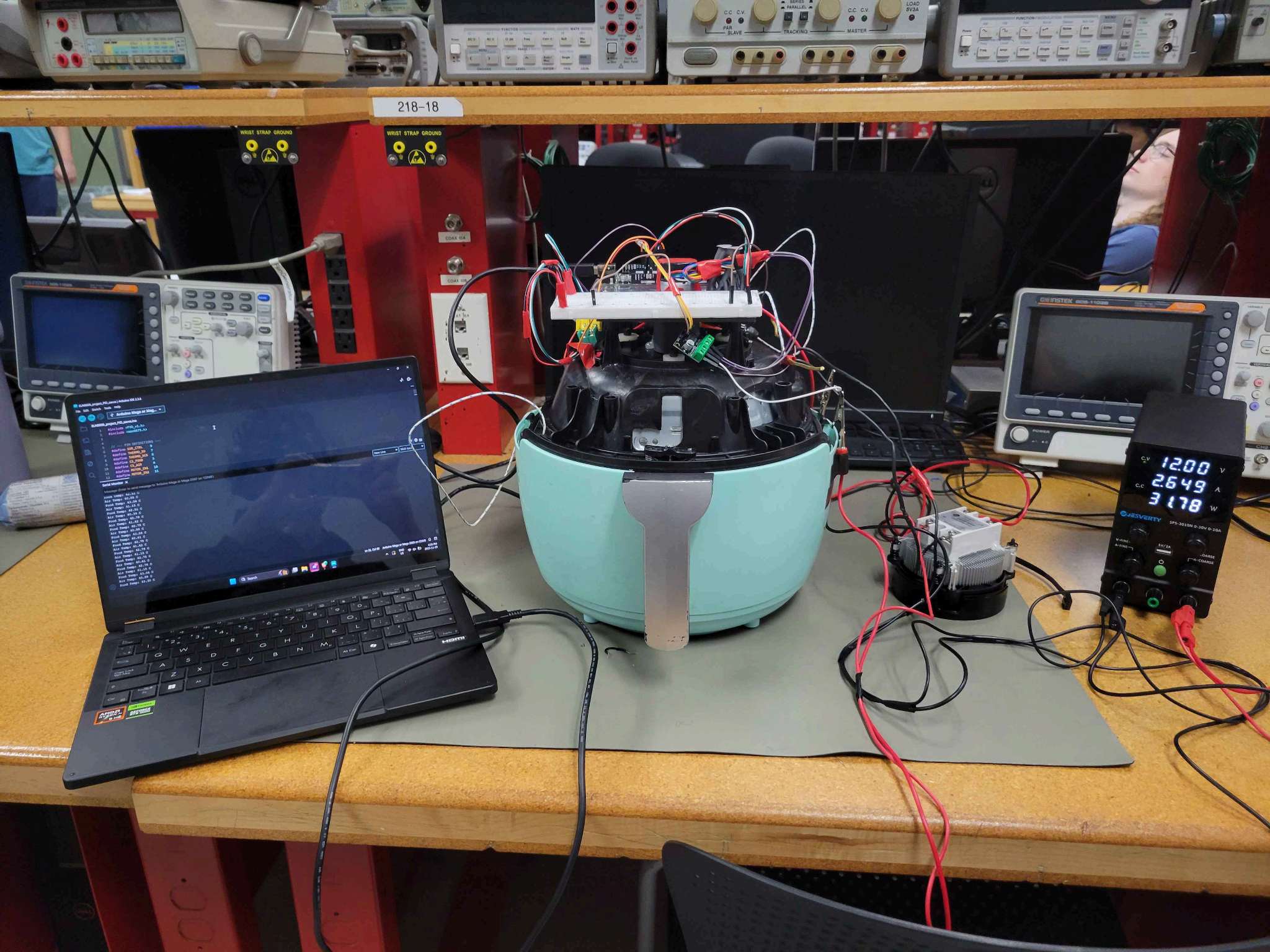
A consumer air-fryer modified into a closed-loop, PID-controlled convection oven for single-portion baking. Twin K-type thermocouples, a MAX6675 SPI interface, a 100 W heater, and an Arduino-tuned PID loop deliver steady, even temperatures inside a custom 3D-printed chamber.
Brownies (and most baked goods) need a consistent, precise environment to come out evenly. Compact ovens are notorious for uneven heat, overshoot during preheat, and slow recovery after door opens. The brief: design a small, fan-assisted convection oven that uses closed-loop control to minimize steady-state error and temperature fluctuations.
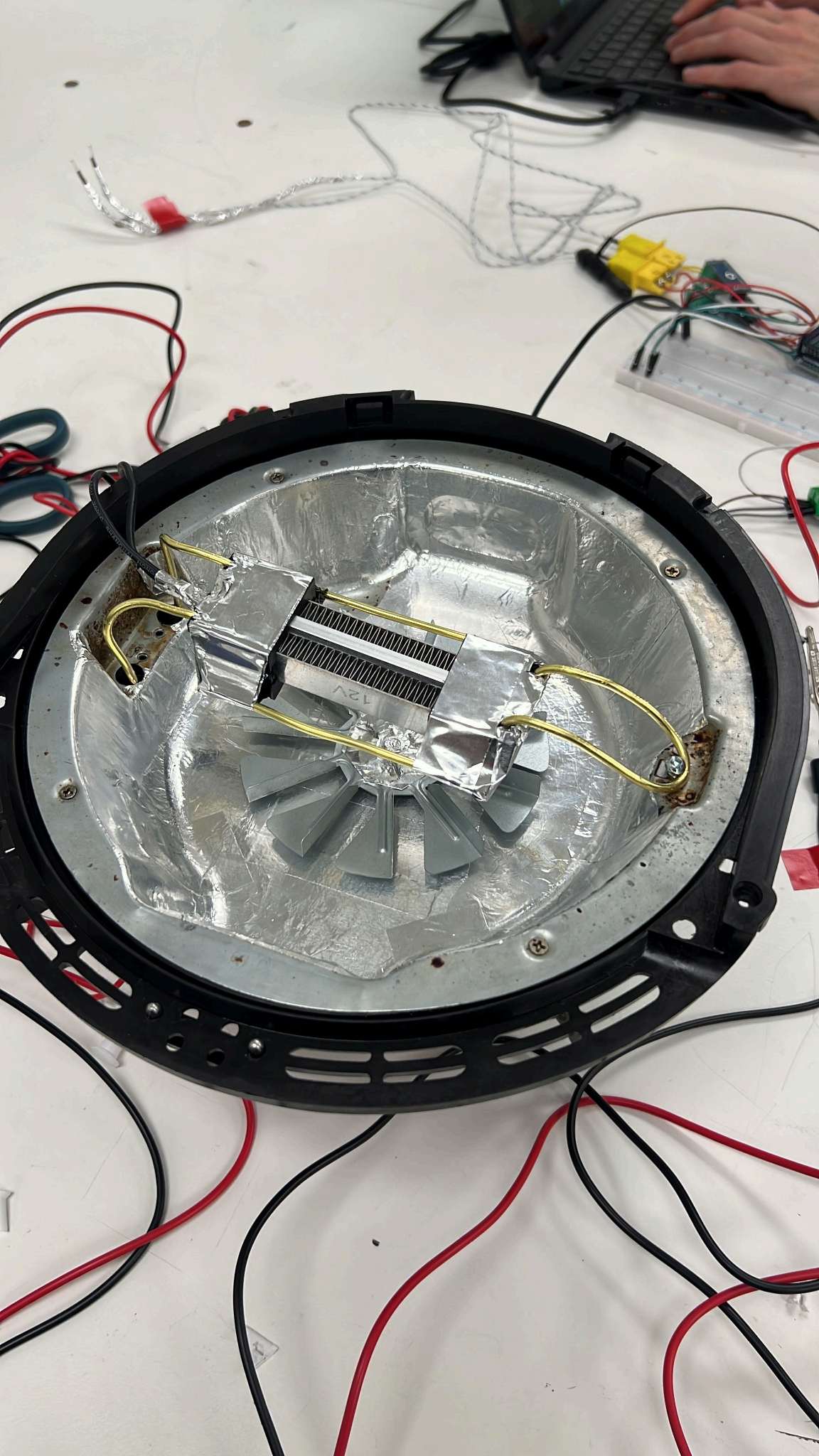
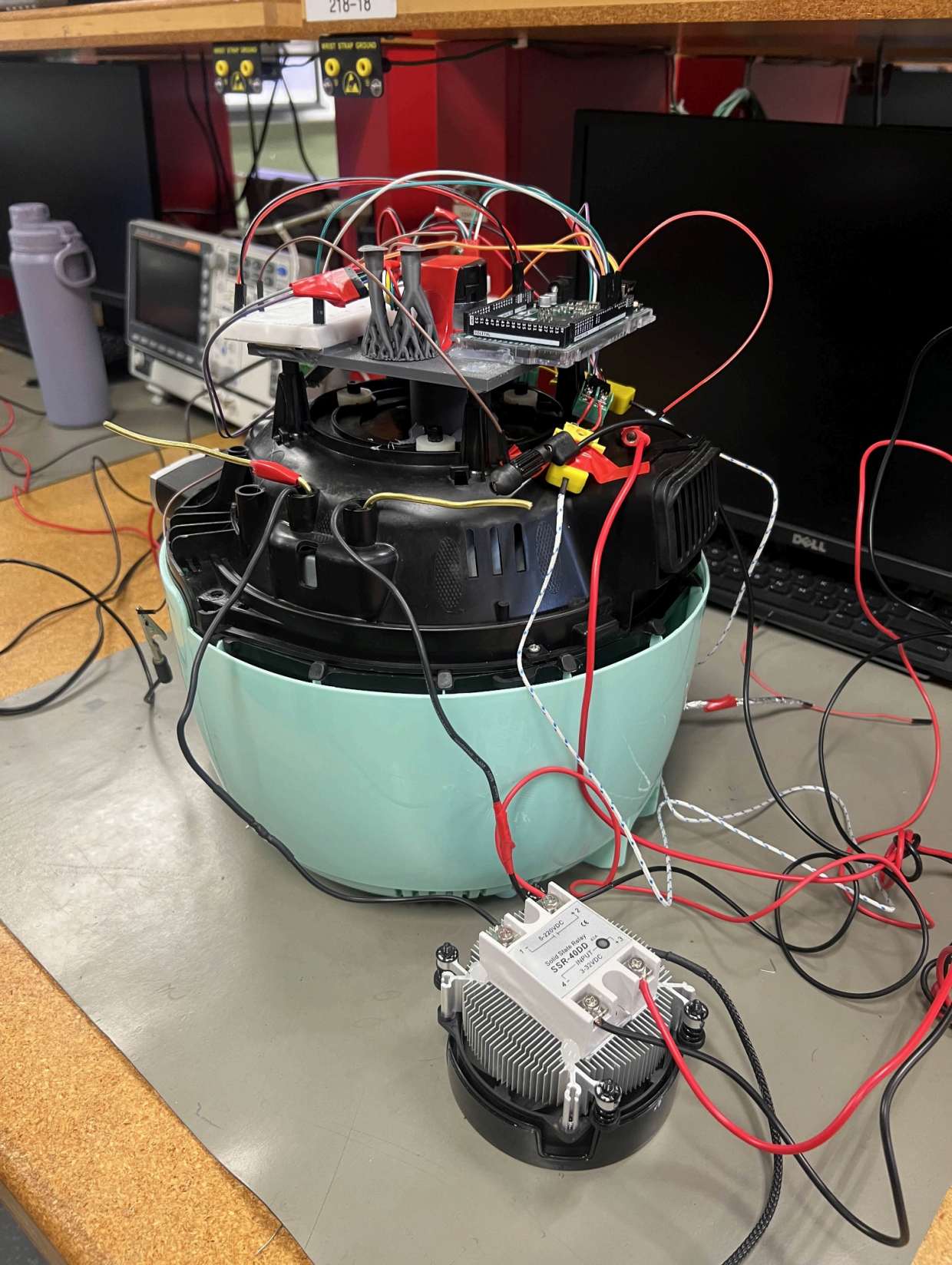
Start from a commodity air-fryer body for proven airflow and insulation. Strip the consumer electronics, wire in a custom heater + fan, and run the loop with an Arduino reading two thermocouples through MAX6675 SPI modules. Drive the heater via a solid-state relay using a slow PWM signal whose duty cycle is set by a tuned PID controller.
The Arduino samples the chamber temperature, computes the error against the target, and asks the PID library for a fresh control signal. That signal is converted into a PWM duty cycle and fed to a solid-state relay driving the heater. A second thermocouple monitors the heater itself for safety and mathematical-model checks.
Two bead-tip K-type thermocouples report through MAX6675 SPI modules. A calibration pass against a reference probe is applied per channel before the loop runs.
The Arduino PID library combines proportional, integral, and derivative terms to produce a 0-255 control signal. Tuning followed a manual + Ziegler-Nichols-style approach iterated on the bench.
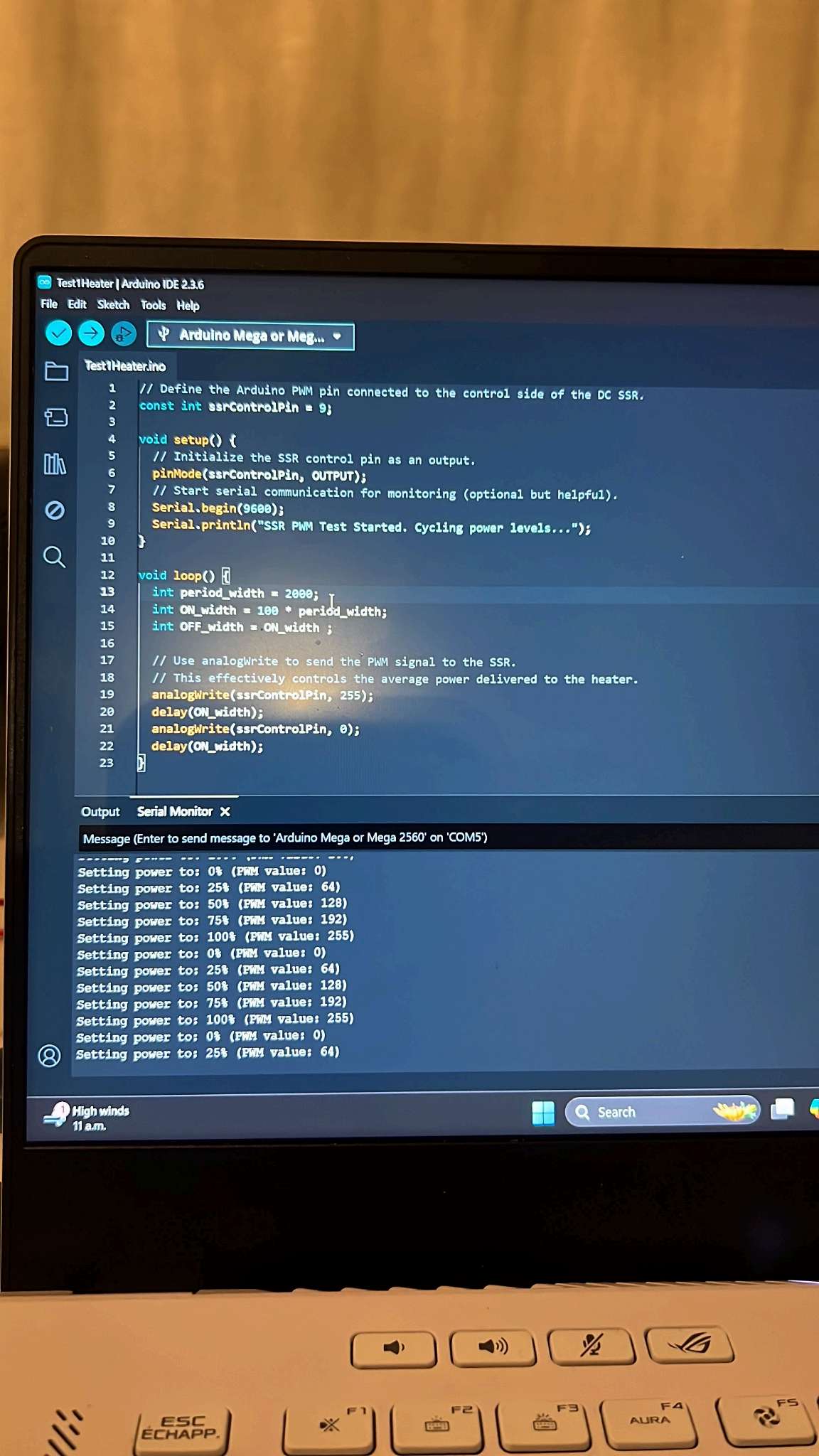
A pinMode → analogWrite block on a dedicated control pin produces a slow PWM signal. The SSR switches the 100 W heater on and off in proportion to the duty cycle — efficient and silent, no contactor wear.
A high-temperature fan circulates air around the chamber, equalizing the temperature field and improving heat transfer to the food. The second T/C verifies that internal air, not just the heater surface, is at setpoint.
After preheat overshoot is contained by tuning, the system holds within a tight band around setpoint long enough to bake a single brownie consistently end-to-end.
The PID-controlled chamber held a stable temperature with significantly less overshoot than the un-modified appliance. Sensor calibration and tuning iterations made the difference between a chamber that hunted around setpoint and one that settled in cleanly. The bonus objective — actually baking a brownie — was achieved end-to-end.