Back to engineering projects
// PRJ_002 · Robotics & Automation

Automated
Robotic Bartender.

A FANUC LR Mate 200iD industrial cell that pours custom drinks end-to-end: HMI recipe selection, PLC ladder logic, weight-feedback ice dispensing, and mechanical Bar Butler nozzle pressing — all coordinated by a single push of a button.

Project type
Robotics automation cell
Role
Integration · Controls & mechanical design
Core systems
FANUC · PLC · HMI · dispenser
Focus
End-to-end drink automation
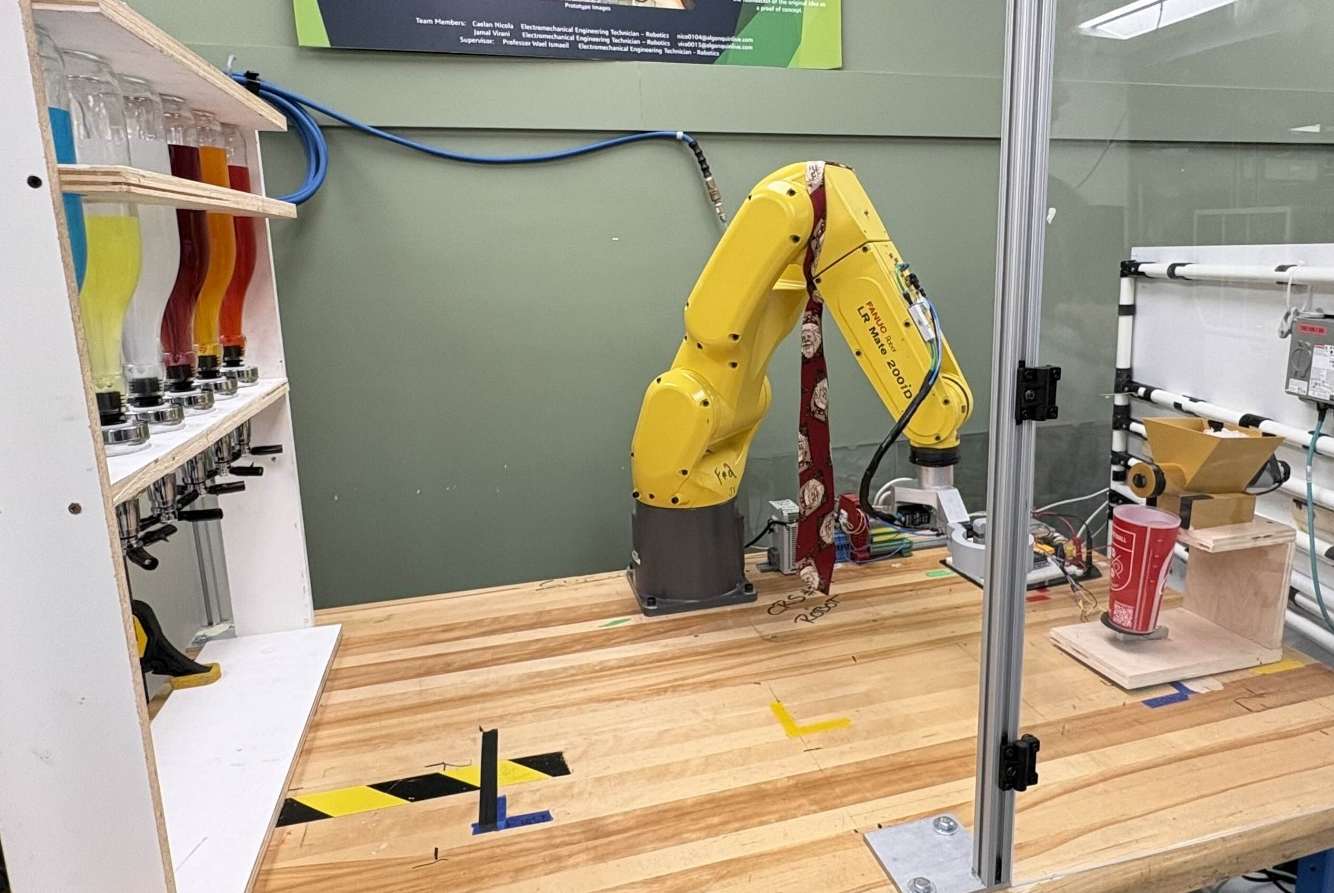
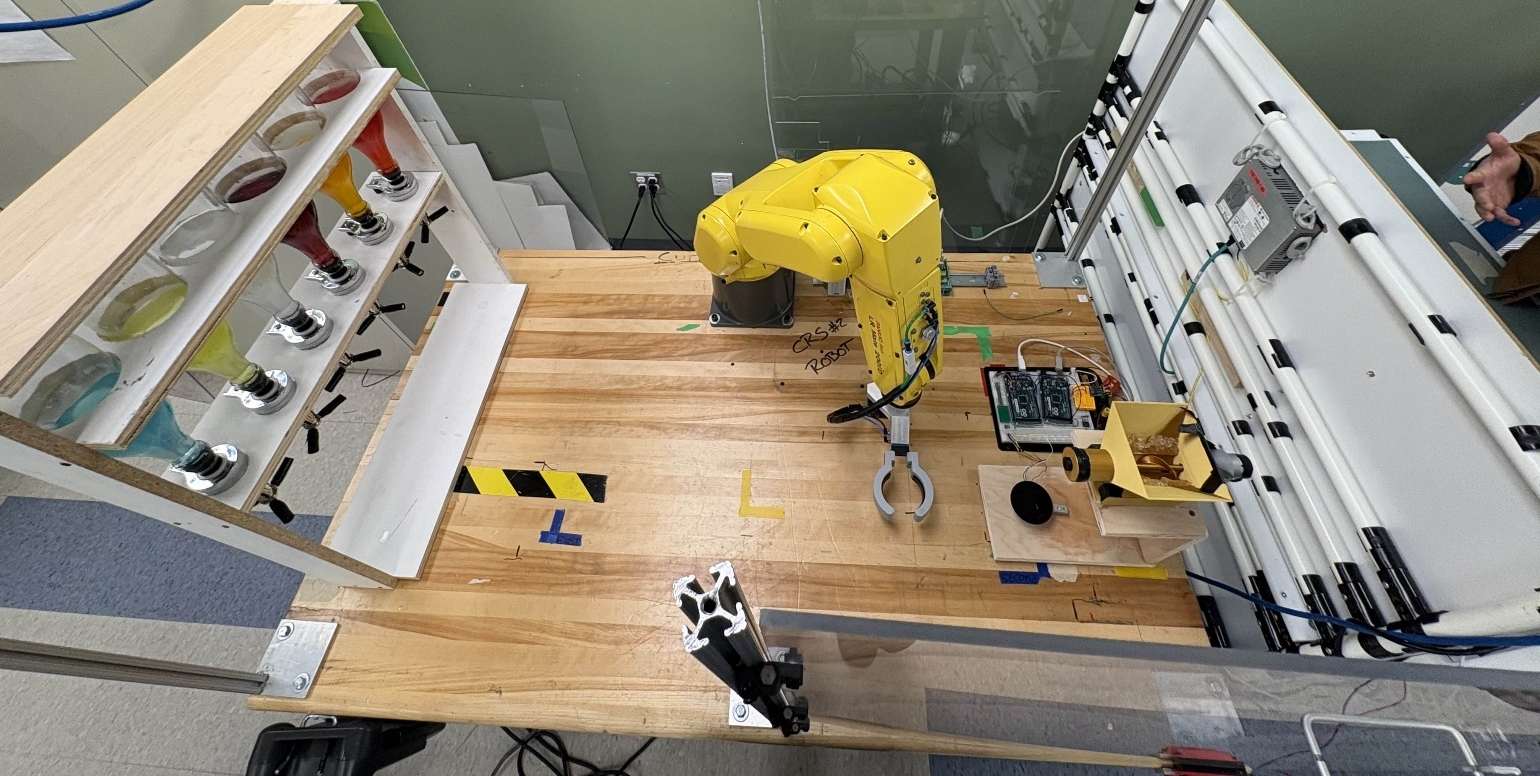
The full FANUC robot cell with liquid bottles and ice dispenser
// FANUC LR Mate 200iD · full cell
Robot
FANUC LR Mate 200iD 6-axis · ISO 10218
Liquid dispense
45 mL / shot Bar Butler nozzles · 6 channels
Ice accuracy
±1 g across 8 trials at 40 g target
Total BOM
$58.03 CAD under the $100 budget
// 01 — Problem

Closing the loop on multi-ingredient drink pouring.

Existing automated bartenders focus on liquids and treat ice as a manual step. Commercial portion-control dispensers are accurate but locked-down, proprietary, and rarely use sensor feedback. The brief: design a fully-integrated cell where a 6-axis industrial robot, weight-based mechatronic ice dispensing, PLC logic, and a structured HMI cooperate to pour a complete drink — accurately and repeatably.

Constraints & standards

  • PLC programming per IEC 61131
  • 6-axis robot operation per ISO 10218
  • Food-safe materials in all liquid- and ice-contact paths
  • Safe electrical separation between robot and dispensing hardware
  • Repeatable calibration across all liquid channels

Design selection

Four concepts were scored against weighted criteria: feasibility, cost, safety, compliance, scalability, innovation, alignment, appearance, industry impact. The Nozzle Press + Ice Dispenser concept won (385 vs 297, 327, 319) for its balance of educational value, safety, and feasibility.

// 02 — System Flow

From HMI tap to finished drink.

The user picks a drink on the HMI; the PLC translates the recipe into digital input flags for the FANUC controller; the robot executes a deterministic path through the ice and liquid stations. Sensor feedback gates each stage.

Recipe selection on HMI

The user opens Signature Drinks or Make Your Own. The display cup updates with the chosen ingredients (Ice, Blue, White, Red, etc.) using D1-D5 / R1-R4 graphic instructions.

PLC encodes the order

IEC 61131 ladder logic reads the selection and sets digital outputs (DI[101-108]) consumed by the FANUC teach pendant program — e.g. Ice = 1, Blue = 1, White = 1, Red = 1.

Robot fetches ice

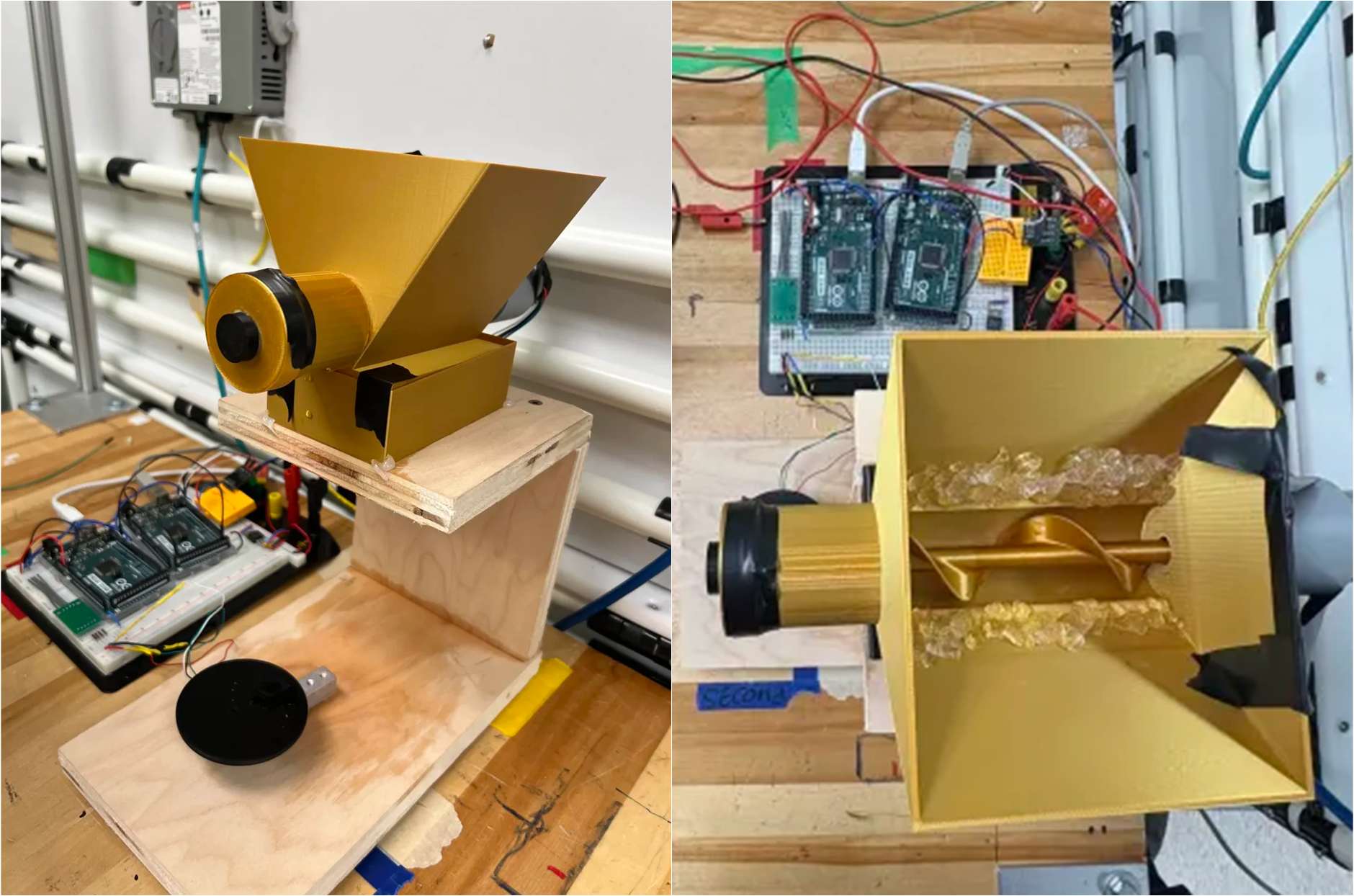
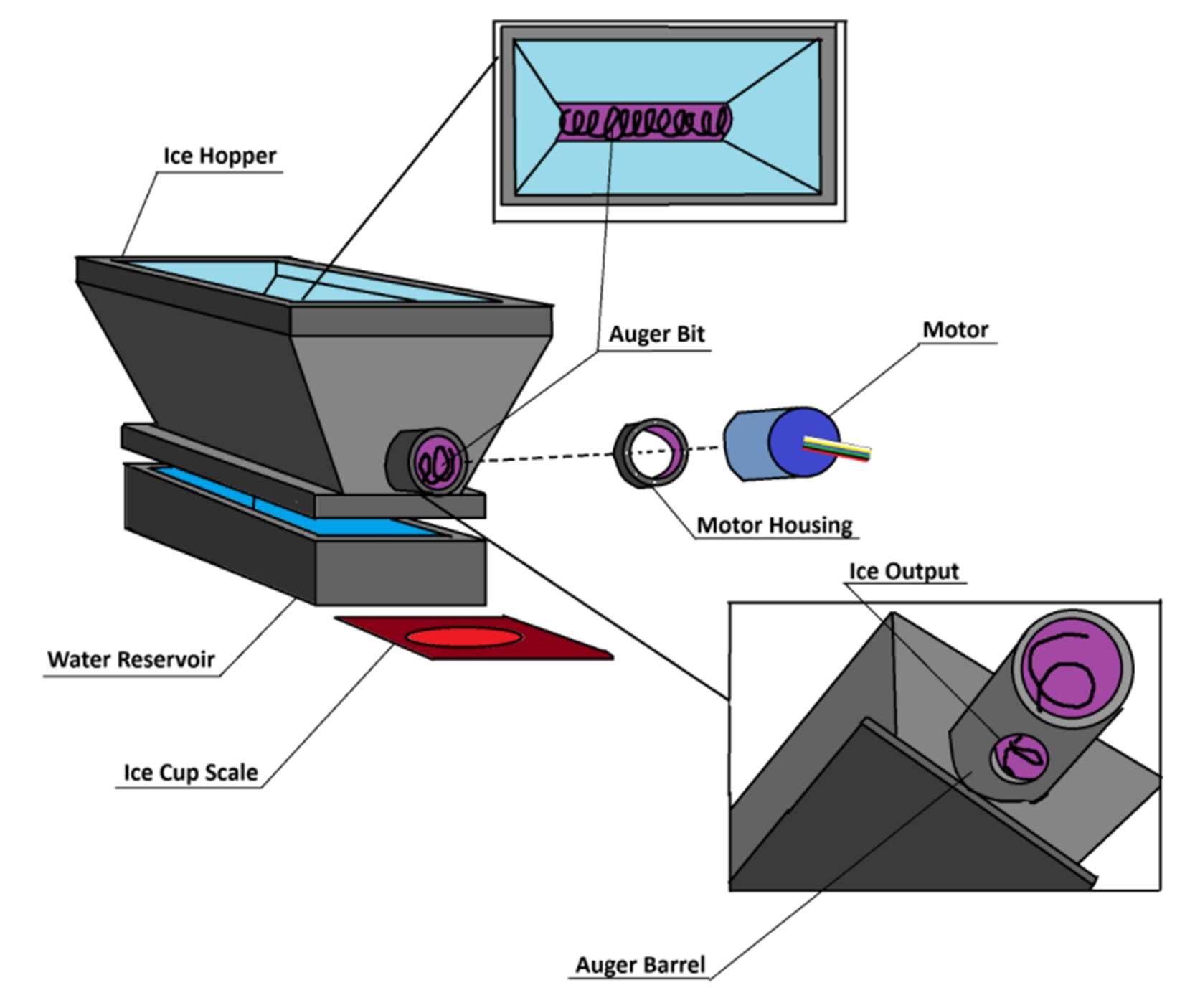
With the cup already in its gripper, the FANUC moves to the ice dispenser and places the cup on the load-cell scale. The Arduino auger runs until the cup hits the 40 g target, then stops via digital signal.

Liquid dispensing at the bar wall

The robot picks the cup back up and visits the wall-mounted Bar Butler nozzles, mechanically pressing each selected nozzle once for a precise 45 mL pour. Multiple presses scale the portion for stronger drinks.

Hand-off & reset

The completed drink is brought to the serving station. The cell resets, the HMI returns to the main menu, and the cup is re-oriented in the gripper for the next order.

// 03 — Subsystems

Four subsystems, one orchestrated cell.

Mechatronic ice dispenser

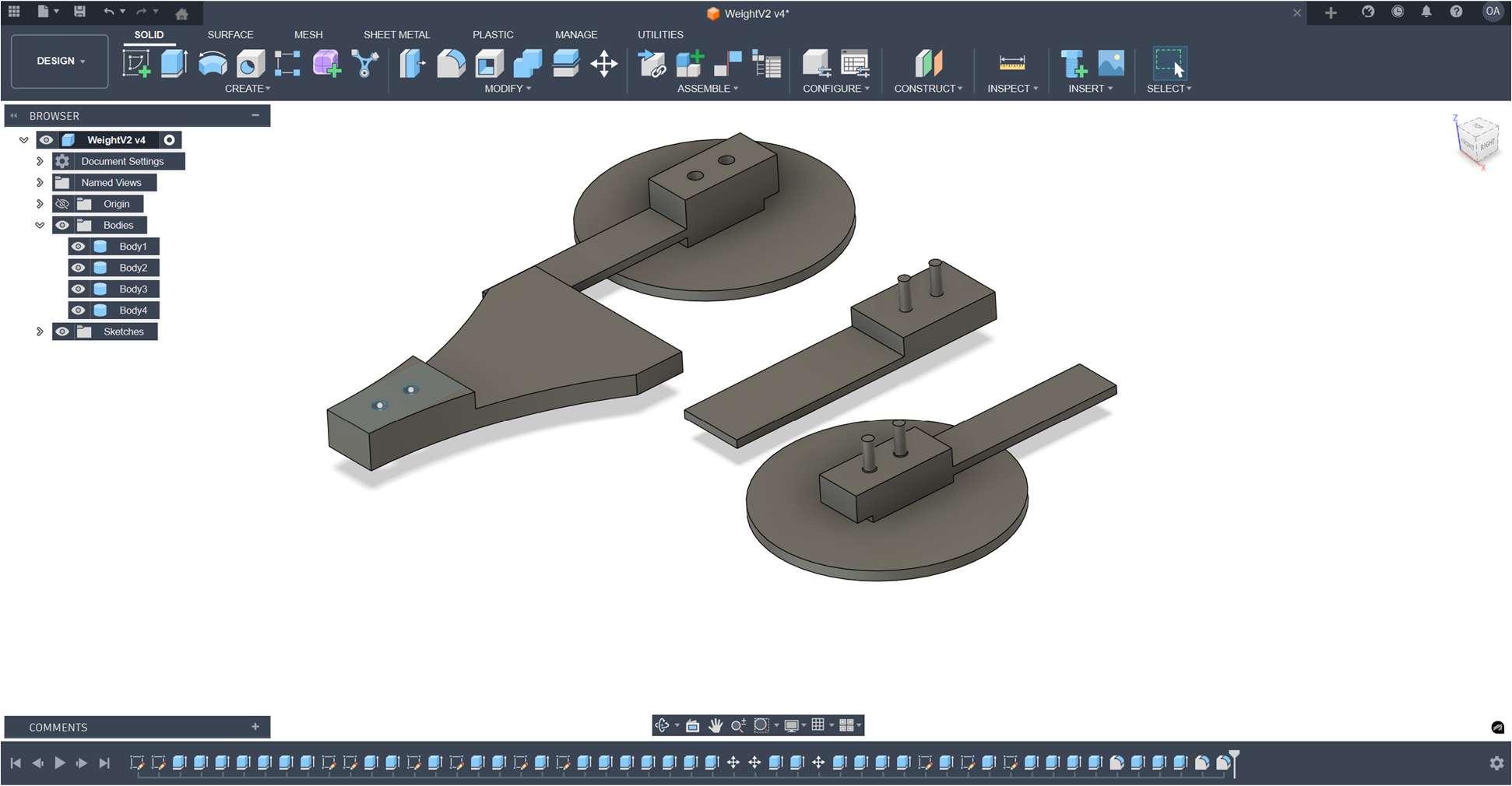
Two Arduino Megas: one runs the HX711 + 5 kg load cell with food-safe filament; the other runs SR-latch motor logic that drives a 12 V auger. Hopper, auger, and barrel were modeled in Fusion 360 / SolidWorks 2023 and printed in PLA.

Bottle frame & nozzles

Cabinet plywood (food-safe) frame with four shelves: clamp-down base, Bar Butler array, bottle-support shelf, and a removable top retainer for refills. Six 45 mL nozzles fixed to the array shelf, bottles inverted above.

PLC + HMI

HMI screens use a dark-blue gradient and consistent button styling. A live "display cup" with 4 rectangles + 5 disks renders the current selection in real time. Ladder logic enforces IEC 61131 modularity for clarity and maintainability.

FANUC robot & gripper

FANUC LR Mate 200iD controlled by teach pendant. Custom gripper went through five iterations to reliably hold the cup through ice loading and nozzle presses. Digital interlocks (DI[101-108]) prevent unintended motion if a person enters the workspace.

FANUC LR Mate 200iD FANUC Teach Pendant PLC ladder logic IEC 61131 HMI design Arduino Mega 2560 HX711 + load cell Fusion 360 SolidWorks 2023 Food-safe PLA Bar Butler nozzles
// 04 — Validation & Risk

Eight trials, ±1 g of error.

The mechatronic ice dispenser was tested across eight repeat trials at the 40 g target, with measured weights of {41, 39, 40, 41, 40, 39, 40, 40} g. Maximum error was ±1 g — within the project accuracy goal. Robot pathing was validated iteratively; the gripper claw passed through five revisions to settle alignment and grip force across the dispense and press tasks.

Reviewer feedback

  • Accepted — Vincent: print ice-contact parts in food-safe filament. Implemented for final build.
  • Modified — Rhys: improve wiring security and operator separation from robot path.
  • Rejected — Brian Gray (expert): improve ice-flow consistency further; tradeoff vs. course timeline.

Risk mitigation

  • Robot speed limited; teach pendant disengages on operator approach
  • Reverse-direction unjam routine for the auger drive
  • Operator never reaches into the cell during a sequence
  • Food-safe materials throughout the ice path; drinks transferred out before serving
// 06 — Outcome

Faster, more repeatable than a human.

The completed cell demonstrates a fully-integrated automation loop: a 6-axis industrial robot, weight-based mechatronic ice dispensing, PLC-driven logic, and a structured HMI all cooperating on a single drink order. Manual pouring is inconsistent and slow; this system delivers faster, more repeatable results while staying inside both the budget and the standards constraints.

What worked

  • Concept-scoring matrix landed on the right design tradeoff early
  • Splitting sensing and motor logic across two Arduinos kept each program clean
  • HMI display cup gives the operator a real-time visual of the recipe
  • BOM came in well under budget with most parts course-supplied

What I'd change

  • Add a vibratory or anti-bridging feature to the hopper for higher ice consistency
  • Replace teach-pendant programming with a proper offline-programming workflow
  • Migrate the Arduino interface to direct PLC I/O for tighter timing guarantees